
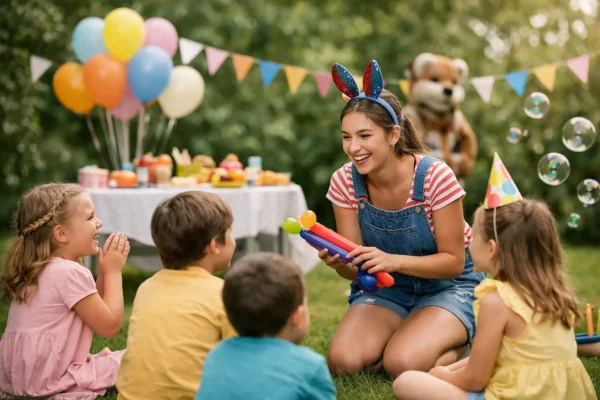
A room full of excited children can turn noisy very quickly. One minute they are smiling for photos, the next they are racing between chairs, asking for cake early, or losing interest in the game you spent all week planning. If you are wondering how do you entertain children's parties in a way that feels fun for the kids and manageable for the adults, the answer is not more activities. It is better structure.
Parents often assume party entertainment means filling every minute with games, prizes, music and sugar. In reality, children enjoy parties most when someone confident is leading the room, the energy rises and settles at the right moments, and the programme matches their age. That is what keeps a party exciting without letting it become chaotic.
How do you entertain children's parties without losing control?
The best children's parties are not built around random activity ideas. They are built around attention. Children between 3 and 12 do not all respond to entertainment in the same way, and even within one party, energy can shift fast. A group of four-year-olds at home needs a very different pace from a group of nine-year-olds in a condo function room.
That is why strong party entertainment is usually performer-led rather than parent-managed. When one person takes charge of the flow, children know where to look, what to do and when to settle down. That keeps them engaged while also taking pressure off the adults in the room.
A good party entertainer does more than perform. They read the children, adapt the pace, keep the birthday child included, and move the party from one moment to the next without awkward gaps. That matters far more than having a long list of games.
Start with the age of the children
If you want the party to go well, start by being realistic about what the children will actually enjoy.
Children aged 3 to 5 usually respond best to visual, interactive entertainment with very clear instructions. They like joining in, laughing together, and feeling part of the action, but they can lose focus quickly if an activity runs too long. For this age group, shorter segments and lots of guided participation work well.
Children aged 6 to 8 often enjoy a stronger mix of comedy, simple competition and audience interaction. They want to feel involved, but they can also follow a more developed show structure. This is often the age where a live performance, such as an interactive comedy act or puppet show, really works because they are old enough to follow the story and young enough to love the silliness.
Older children, around 9 to 12, usually need entertainment that respects their growing confidence. They still want to have fun, but they are less impressed by anything that feels too babyish. At this age, the entertainer's personality, humour and ability to hold the room matter a great deal.
The point is simple. Entertainment should be chosen for the children in front of you, not just because it looked nice in a photo.
Space matters more than most parents expect
One of the biggest worries parents have is whether their venue is suitable. Maybe you are hosting at home. Maybe it is a condo function room. Maybe the space is smaller than you hoped. That does not mean the party cannot be a success.
You do not need a huge venue to entertain children well. What you need is an activity style that fits the room. Some entertainment needs children to run around constantly. Other types work brilliantly in compact spaces because the fun comes from interaction, storytelling, laughter and guided participation rather than endless movement.
This is where experience makes a real difference. A seasoned entertainer knows how to manage the room they are given. They know how to position the children, how to work around furniture, how to keep the birthday child at the centre, and how to create excitement without turning the party into a free-for-all.
For parents, that means less stress. You are not trying to reinvent your living room as a playground. You are choosing entertainment that works with your venue instead of fighting against it.
Why structure beats a pile of party games
Many parents begin by thinking they will just organise a few games themselves. On paper, that sounds easy. In practice, it often means stopping conversations, raising your voice, chasing the children back into the room, and trying to keep everyone happy while also handling cake, food and guests.
This is why structured entertainment is so effective. Instead of the party drifting, there is a clear flow. The children arrive, settle in, get drawn into the programme, enjoy the main entertainment, and move naturally towards the next part of the celebration. It feels smooth because someone is leading it.
That does not mean every party needs to be rigid. Children need moments of excitement and moments of calm. They need space to laugh loudly and also time to sit, watch and react together. The trick is balance. Too much high-energy play and the room becomes hard to manage. Too much passive watching and they become restless.
A well-run party blends both.
What actually keeps children engaged?
If you strip away the decorations, the children remember how the party felt. Did they laugh? Did they feel involved? Did the birthday child feel special? Were there dull moments where everyone started wandering off?
The strongest party entertainment usually includes direct interaction. Children stay focused when they are not just watching but responding, shouting out answers, joining in the fun, and feeling like the entertainer sees them. That is one reason live performance works so well. It creates a shared experience in the room.
For many family parties, a performer-led show with built-in audience participation can do far more than several disconnected activities. A good ventriloquism puppet show, for example, gives children a character to connect with, comedy to react to, and enough structure to hold attention across different age groups. It also gives adults a chance to step back rather than constantly manage behaviour.
That is one of the reasons parents booking with Explorer Joe often want more than just an act. They want a party that feels handled.
How do you entertain children's parties and still enjoy the day yourself?
This is the part many parents forget to ask. Yes, the children should have a brilliant time. But if the adults are overwhelmed, the party can still feel exhausting.
The most helpful entertainment reduces your workload. You should not have to plan every game, control the group, fill every silence or keep dragging attention back. A professional entertainer takes on that role and gives the event a centre. That allows you to welcome guests, take photos, serve food and actually enjoy your child's birthday.
There is a trade-off, of course. A do-it-yourself party may seem cheaper at first, especially if you already have decorations and a playlist ready. But the hidden cost is often your own time and energy. If you spend the whole party coordinating activities, you do not really get to be present for it.
For many families, that is exactly why booking proper entertainment makes sense.
Choosing the right entertainment for your party
Not every party needs the same format, and that is where parents should be selective. Ask whether the entertainment is age-appropriate, suitable for your space, and capable of holding attention for the group size you expect. Ask whether the entertainer simply appears for a performance or actually helps lead the party.
That difference is important. Some acts are enjoyable in short bursts but do not shape the event around them. Others are designed to guide the room, keep children engaged while parents relax, and create a smoother overall experience.
It also helps to think about your child. Some children love high-energy participation. Others are shy at first and warm up gradually. A good entertainer can adjust for that, making the birthday child feel included without putting them under pressure.
If you are planning a celebration in Singapore and want something that works in real family spaces, from homes to condo venues, it is worth looking at options that are designed to manage both the fun and the flow. You can see more at https://Singaporebirthdayparty.com.
A children's party does not need to be bigger, louder or busier to be memorable. It just needs the right kind of energy in the room, guided by someone who knows how to keep children happy and the whole event moving. When that happens, the party feels easy – and that is when everyone enjoys it more.