
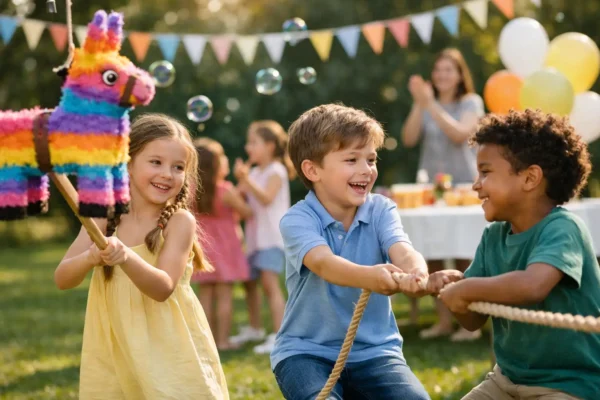
The tricky moment usually comes about 20 minutes in. The birthday child is excited, a few children are running in different directions, one is shy, one is too energetic, and parents start wondering who is actually in charge. If you are asking how to keep children engaged party planning becomes much easier when you stop thinking about filling time and start thinking about leading the room.
Children do not stay engaged because there are lots of things available. They stay engaged because the party has momentum. That means the entertainment needs a clear flow, the activities need to suit the age group, and someone needs to confidently guide what happens next. When that happens, the party feels fun for the children and far less stressful for the adults.
How to keep children engaged party planning starts with structure
A common mistake is assuming children only need games. In reality, they need rhythm. Too much unstructured time can make a party feel chaotic, especially in homes and condo function rooms where space is limited and energy builds quickly.
A well-run children’s party has a beginning, middle and finish. The opening needs to gather attention fast. The middle should vary the pace so the children are not doing the same thing for too long. The final stretch should bring everyone back together before cake, photos or food. This sounds simple, but it is exactly what keeps children focused without parents having to constantly step in.
The strongest parties are led, not improvised. Children respond well when they know something fun is always about to happen. That anticipation is what keeps them with you.
Start with an activity that gathers the room
The first activity matters more than most parents expect. If it is too passive, the children drift away. If it is too energetic too early, the room can become difficult to settle. A good opener is interactive, easy to join, and does not make late arrivals feel left out.
This is why performer-led entertainment works so well. Instead of expecting parents to gather the children and explain rules, the entertainer takes control of attention from the start. The children know where to look, when to respond and how to join in. That one shift can change the entire feel of the party.
Match the entertainment to the age group
If you want to know how to keep children engaged party choices must match the children in front of you, not just what sounds exciting on paper. A group of four-year-olds and a group of ten-year-olds need completely different pacing, language and humour.
Younger children usually engage best with visual, interactive entertainment and simple instructions. They need quick transitions and lots of participation without long waiting times. If an activity requires too much explanation, you may lose them before it begins.
Older children can stay with a longer format, but only if it feels lively and clever. They want to be included without feeling talked down to. They also respond well to entertainment with personality, especially when there is humour, audience interaction and a sense that anything could happen next.
Mixed-age groups are where many parties become messy. The solution is not to please everyone with separate mini-programmes. It is to choose entertainment that can flex across ages while still keeping a clear group focus. A skilled children’s entertainer knows how to adjust tone, speed and audience involvement as the room changes.
Keep transitions short and purposeful
Children often lose interest in the gaps between activities, not during the activities themselves. Waiting for props, moving furniture, deciding what comes next or calling everyone back from another corner of the room can quickly drain energy.
That is why smooth transitions are so valuable. Every part of the party should lead naturally into the next. If games end, the next moment should already be ready. If food is coming, the children should be guided there, not left to scatter and regroup.
This is also where many parents feel the pressure. They are trying to host guests, serve food, answer questions and still keep the children on track. A structured entertainment programme removes that burden. Instead of managing every transition yourself, you have someone experienced controlling the flow.
Space matters less than parents think
Many families worry they need a large venue to keep children entertained. In practice, space helps less than structure. A big room without direction can feel more chaotic than a small room with a well-led programme.
Home parties and condo celebrations can work brilliantly when the entertainment is designed for the space. The key is choosing activities that do not rely on children constantly running around. Audience-based interaction, character-led performance and guided participation can hold attention extremely well even in more compact settings.
That is good news for parents in Singapore, where parties often happen in living rooms, function rooms or sheltered common areas. You do not need a huge setup to create a strong party atmosphere. You need the right pacing and someone who knows how to work the room.
Variety keeps energy up, but too much can backfire
Parents sometimes try to pack in everything – games, music, crafts, free play, balloons, cake, prizes and more. It comes from a good place, but too many moving parts can actually make the party feel less engaging.
Children enjoy variety when it is curated. They do not need constant novelty. They need a few well-run moments that each feel distinct. High-energy interaction followed by a more focused performance segment often works better than a long run of shouty games. In the same way, a funny puppet routine or interactive show can settle the room while still keeping excitement high.
The trade-off is simple. More activities can sound impressive, but fewer, better-led activities usually create a smoother and more memorable experience. That matters when your real goal is not to impress adults with a packed schedule but to keep children happily involved from start to finish.
Why performer-led parties hold attention better
There is a difference between entertainment that happens at a party and entertainment that leads a party. The second is what most parents are actually looking for.
A professional children’s entertainer does more than perform. They read the room, bring shy children in gently, calm overexcited moments without killing the fun, and adjust the pace before attention starts to drop. That experience is hard to replace with a playlist and a set of downloaded games.
This is especially helpful at birthdays where parents want to enjoy the celebration too. You should not have to spend the whole event refereeing turns, raising your voice over the noise, or inventing backup plans when something falls flat. With the right entertainer, the children stay engaged while the adults can actually watch, take photos and enjoy the day.
That is why many families choose a managed experience rather than piecing things together themselves. A structured show with interactive elements, age-appropriate humour and confident crowd control gives you something every parent values – fun that feels under control.
Practical ways to keep children engaged at a party
The most effective approach is usually the simplest. Plan around attention span, not just duration. Keep the children together early, vary the pace through the middle, and use entertainment with a clear host or leader.
It also helps to avoid making every child compete all the time. Some love that energy. Others switch off or become upset. Group interaction tends to be more inclusive, especially with younger children and mixed personalities.
If you are booking entertainment, ask whether it is designed for your child’s age, whether it suits your venue, and whether the entertainer actively manages the party flow. Those details matter more than flashy extras. Families booking with Singapore Birthday Party with Explorer Joe often want exactly that balance – plenty of laughter for the children, and the reassuring sense that someone experienced is guiding the event properly.
One more thing is worth remembering. Children do not measure a party by how expensive it looked or how many items were on the programme. They remember how it felt. If they were included, amused and carried along by the excitement, that is what stays with them.
A good children’s party is not about keeping every second busy. It is about creating a flow where the children want to stay with you, and the adults can finally take a breath and enjoy the celebration too.