
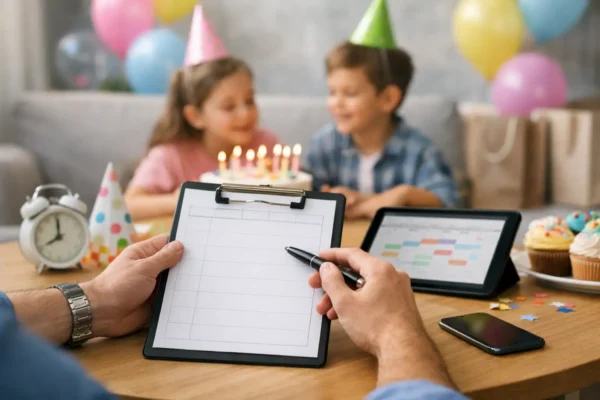
The moment children arrive, your party schedule is already doing one of two jobs – helping the celebration flow, or making you chase the room. That is why parents often search for how to run birthday party schedule plans that actually work in real life, not just on paper. The best timetable is not packed from wall to wall. It is paced properly, gives children something to focus on, and leaves you free to enjoy the birthday instead of directing every five minutes.
For most children’s parties, the real challenge is not finding enough things to do. It is choosing the right order, the right timing and the right person to lead each part. Children between 3 and 12 do not respond well to long gaps, unclear transitions or activities that drag on past their natural attention span. A good schedule keeps energy moving without turning the party into hard work.
How to run birthday party schedule without rushing
A smooth party usually follows a simple rhythm. Children arrive and settle, they join a shared activity, food happens at the right point, the birthday moment feels special, and the event finishes before everyone becomes overtired. That sounds obvious, but many parties become stressful because parents try to fit everything in equally, as if every part needs the same amount of time.
It does not. Arrival time needs breathing room. Entertainment needs a clear start. Food needs a natural break in energy. Cake needs attention and a little ceremony. After that, the finish should come quite soon, especially for younger children.
As a guide, a 2-hour party is often the easiest length to manage at home or in a block of flats' function room. It is long enough for children to feel they have had a proper celebration, but short enough to keep the mood lively. Three-hour parties can work too, though they need stronger pacing and are less forgiving if one section runs late.
Start with the age of the children
If you are working out how to run birthday party schedule timings, begin with the children’s age, not the venue or even the menu. Younger children usually need faster transitions, simpler instructions and more structure. Older children can cope with slightly longer group activities, but they still benefit from a host who keeps things moving.
For ages 3 to 5, shorter segments work best. They are excited quickly, distracted quickly and often take time to settle when they first arrive. You want an easy arrival window, a strong entertainer-led middle section, then food and cake before energy drops.
For ages 6 to 8, you have a little more flexibility. They enjoy anticipation and can stay with a performance or interactive game for longer, provided it is lively and age-appropriate. For ages 9 to 12, the tone matters more. They still want fun, but they do not want to feel they are being talked down to. The schedule should feel brisk and confident rather than overly managed.
A party schedule that works for most families
A practical 2-hour schedule often looks like this. Guests arrive over the first 15 to 20 minutes while children have a simple settling-in activity or free mingling. Then the main entertainment begins while everyone is present and paying attention. After that comes food, followed by cake, singing, photos and the final wind-down before collection.
If you prefer clearer timings, think in this pattern: 20 minutes for arrivals, 45 to 60 minutes of led entertainment, 20 minutes for food, 10 to 15 minutes for cake and photos, then the remaining time for goodbyes and collection. That structure works because it puts the strongest engagement in the middle, when the room is full and children are ready to join in.
The main mistake parents make is serving food too early. Once children sit down to eat, energy changes. Some children become distracted, some want to walk around, and some need longer than others. If you place food before your main entertainment, it can be harder to gather everyone back into one group. There are exceptions, especially if the party falls over a usual meal time, but for many home parties, entertainment first works better.
Build the schedule around attention, not just activities
This is where many timetables fall apart. Parents often plan by category: welcome game, game, food, game, cake, game. On paper, that looks full and exciting. In practice, it asks the adult host to repeatedly stop one thing and start another while keeping children focused. That is tiring.
A better approach is to build the schedule around attention. Ask yourself when children will be easiest to gather, when they are most likely to drift, and when adults need a breather. One well-led entertainment block often does more for the party than several separate mini activities that you have to explain yourself.
That is one reason performer-led parties are such a relief for parents. When an experienced entertainer controls the flow, children know where to look, what to do and when to respond. It is not just about being funny or energetic. It is about pacing the room so the party keeps moving and parents are not left trying to herd twenty excited children into the next activity.
Leave space for late arrivals and real-life delays
No birthday party ever runs exactly to the minute. Someone arrives late. A child needs the loo. Grandparents want a photo. The food turns up five minutes behind schedule. If your timetable is too tight, one small delay throws everything off.
So if you are thinking about how to run birthday party schedule plans properly, build in cushion time. Not huge empty gaps, just sensible flexibility. Keep the arrival period forgiving. Avoid stacking too many separate moments. And if one key item matters most to you, such as the performance or the cake presentation, protect time around it.
In Singapore especially, where many parties happen in homes or shared blocks of flats, practical details matter. Lift access, guest check-in, room set-up and weather can all affect timing more than people expect. A realistic schedule always beats an ambitious one.
Who is leading each part?
This question changes everything. If you are running the full party yourself, your schedule needs to be simpler than if you have a professional entertainer leading the main programme. Parents often underestimate how much energy goes into speaking over the noise, getting children to sit, restarting attention and managing transitions.
If you are hosting alone or mainly with family help, keep your plan very straightforward. Choose one central activity rather than several. Make food easy to serve. Put cake near the end. Accept that less structure is fine if expectations are realistic.
If you have an entertainer leading the main section, let the schedule support that. Give them a clear start time once most guests have arrived. Do not sandwich the performance between too many interruptions. The strongest flow usually comes when children arrive, settle, then move into a focused led programme that carries the room before food.
Explorer Joe parties are built around exactly this kind of structure – keeping kids engaged while parents relax and enjoy the celebration instead of constantly managing it. That works especially well in family homes and blocks of flats where space may be limited but attention still needs to be led with confidence.
Common schedule mistakes to avoid
The first is doing too much. More activities do not automatically create more fun. Often they create more waiting, more explaining and more opportunities for children to lose focus.
The second is leaving children unoccupied during arrivals. This is when the tone is set. If early guests have nothing to do, they start roaming, and the room becomes harder to gather later.
The third is making cake too late. Once children are tired, sugar and excitement can tip into tears or chaos, especially with younger guests. The best time is usually after the main entertainment and before the final wind-down.
The fourth is ignoring the adults entirely. Parents need to know what is happening too. A clear party host, whether that is you or a professional entertainer, helps everyone relax because the event feels under control.
How to know your schedule is right
A good birthday party schedule does not feel packed. It feels easy. Children are engaged most of the time, transitions are short, and you are not constantly improvising. There is enough excitement for the birthday child to feel special, but enough structure for the party to stay enjoyable for everyone else.
If you are still deciding how to run birthday party schedule details, keep this one principle in mind: the best plan is the one you can actually manage with confidence. Children remember the laughter, the attention and the birthday moment. Parents remember whether the whole event felt calm enough to enjoy.
Aim for a schedule that keeps the room together, gives children something fun to follow, and lets you look up long enough to see your child having a brilliant time. That is usually the difference between a party you survive and a party you are genuinely glad you planned.